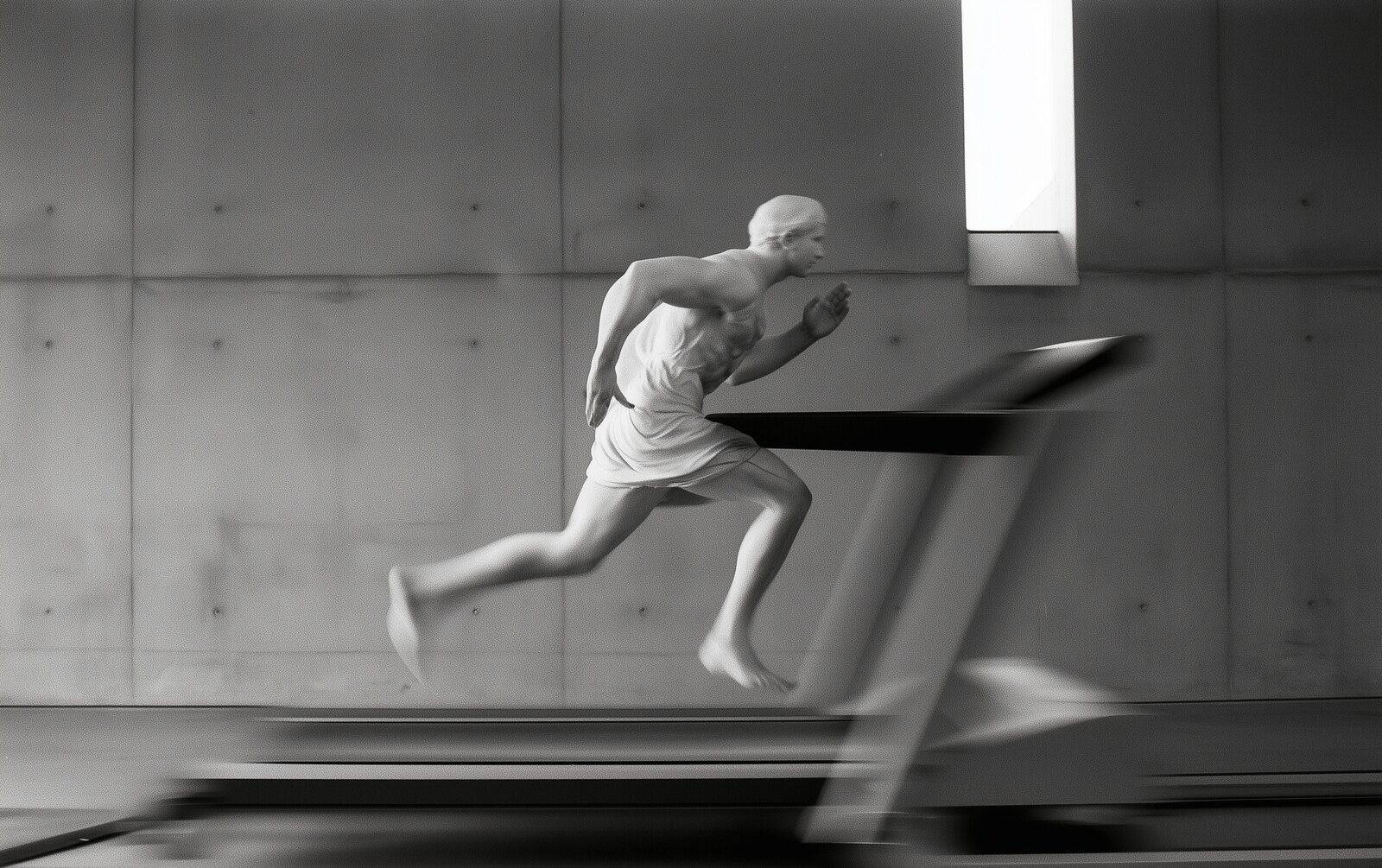
I've been working with AI intensively for roughly two years. At this point, it touches almost everything I do: strategy, research, writing, product work, systems, analysis, design, planning, documentation, building.
Somewhere along the way, I noticed something I wasn't expecting.
Productivity started to feel different. Not just faster. More immediate. More rewarding. More addictive.
The biggest shift AI created for me is not simply that I can do more. It's that there is almost nothing left between wanting something and seeing it.
That distance used to be huge. If I had an idea for a product feature, it went into a backlog. Someone had to scope it, design it, build it, prioritize it against everything else. Then we waited, reviewed it and improved it. The result might arrive days or weeks after the original impulse.
The same was true for strategy. Research something. Run workshops. Read notes. Structure the thinking. Write the document. Build the presentation. Review. Rewrite. A huge part of the work was simply the craft required to turn thought into something tangible.
Today, much of that distance is gone. I can have an idea at 10:50 PM, open my laptop and see a first version a few minutes later. Then improve it. Then improve the system that produced it. Then realize another part could be automated and build that too.
And suddenly it's 2 AM.
The loop is productive. That's the problem.
When I started building ACE, this became especially obvious. At first I was discovering what was possible. Then every feature created another possibility. My systems became better. The models became better. The output became better. The loop became faster.
Better system → better result → more excitement → more building → better system.
You start telling yourself: just one more thing.
The dangerous part is that you're not wasting time. You're producing. Real things are getting better. Problems are being solved. You can point at the output and say: look what I made.
That makes it very different from scrolling Instagram for four hours. You can lose an evening and come out the other side with something genuinely valuable.

Which makes the behavior much easier to justify.
The loop is productive. That's the problem.
Execution is getting cheap. Judgment is getting expensive.
AI hasn't made my work less intense. In many ways, it has compressed the intensity.
A strategic process that previously unfolded across several days can now happen in a few concentrated hours. A meeting gets recorded. The transcript gets structured. Relevant decisions get extracted. Research happens in parallel. A position gets developed, challenged, rewritten and turned into something useful.
The elapsed time goes down, but the cognitive density can go up. You are constantly deciding: Is this correct? Is this actually good? Which direction matters? What is noise? What should survive?
AI can remove parts of the workload while creating far more options to evaluate.

For me, the bottleneck increasingly feels like it has moved.
Execution is becoming cheaper. Judgment is becoming more expensive.
That is mostly a good trade. But something else happens when extreme output becomes normal.
After a few days of producing at a very high level, the unusual starts feeling ordinary. Then a normal day feels slow. A quiet day feels wrong.
Once everything I needed to do was finished, I would find something else: optimize an existing system, revisit an old project, build something I had been thinking about, write an article.
This article is literally an example.
I had a relatively quiet day and started asking myself what else I could create. There was no urgent need for this piece to exist today. I simply wanted to make something.
That is where I started wondering whether productivity itself was becoming part of the reward.
Once extreme output starts feeling normal, normal output starts feeling like failure.
When the pace drops for a few days, I can become restless, mentally overloaded, moody, sometimes strangely empty. The euphoric part of finishing something is short. The desire to get moving again lasts much longer.
Is that dopamine?
Maybe. But this is where I want to be careful.
The internet has turned dopamine into a convenient explanation for almost everything. The actual science is much more complicated, and I haven't found convincing evidence that productive AI use creates some unique dopamine spike or "resets your dopamine baseline."
I wouldn't claim either.
What is more interesting is that problematic AI use is already becoming a real research topic. A recent scoping review of 37 peer-reviewed empirical studies found recurring patterns around compulsive use, cognitive overreliance and psychological or emotional dependence. Those patterns were associated with things like depression, loneliness, social anxiety, escapism and flow states. The authors are equally clear that the field is young, fragmented and still lacks the longitudinal evidence needed to make strong causal claims.
So I don't know whether what I'm experiencing is fundamentally a dopamine problem.
I know it can become a behavior problem.
There is also early evidence that AI dependence can be associated with cognitive fatigue and lower critical-thinking outcomes in some settings. One study of 580 university students found exactly that relationship, with cognitive fatigue partially mediating it. Again: association, not destiny, and students are not the same as professional knowledge workers. But the direction is interesting.
The science does not yet tell us exactly what heavy AI work is doing to us.
But it is giving us enough reason to pay attention.
Some friction was probably protecting us
We spend a lot of time celebrating the friction AI removes. And rightly so. I don't want the old friction back.
I don't miss waiting three weeks to test an idea. I don't miss needing another person simply because I don't possess one specific craft. I don't miss turning every thought into a project plan before I can see whether it has any value.
AI collapses the distance between intention and execution. That is extraordinary.
But I'm starting to think some of the friction we removed had a second function. It forced us to wait, prioritize, sleep on things and ask whether an idea deserved resources. It made it impossible to act on every impulse immediately.
Today, my brain knows that almost every idea is actionable. At 11 PM, I don't have to call my CTO. I don't have to wait until Monday. I can quietly open my laptop and go straight back into the loop.
AI doesn't only remove friction from work. It removes friction from acting on every impulse.
That is one of the reasons I love it.
It is also one of the reasons I think we need to be careful with it.
When progress becomes the default
I suspect this hits certain personalities particularly hard: founders, builders, designers, system thinkers, perfectionists, highly curious people, anyone who derives a lot of satisfaction from making things better.
That is my hypothesis, not science.
But AI is almost perfectly designed to amplify those tendencies. More possibilities. More iterations. Faster feedback. More leverage. More things that could be improved.
For a perfectionist, there is always another version. For a system thinker, there is always another system. For a founder, there is always another problem to solve.
The danger is not that we stop working.
The danger may be that we become unable to tolerate work, life or rest that doesn't provide the same density of progress.
That is where it starts bleeding into everything else.
Administrative work feels even more boring because nothing visible gets created. A call gets postponed. An email waits. An errand moves to tomorrow. You tell yourself you are being productive, and technically you are.
But maybe you are simply choosing the work that rewards you faster.
That is how I can tell the difference between a good AI productivity day and a bad one.
On a good day, I got a lot done. The important things moved forward. I worked in focused blocks. I finished at a reasonable time. Nothing important was displaced by the work.
On a bad day, the output may look almost identical. I may have built something useful, solved difficult problems and made real progress. But I also ignored calls, messages, errands, sleep or time with people I care about because I could not make myself leave the loop.
So I'm starting to think the better question is not: How much did I produce?
It is: What did my productivity make me neglect?
I still don't want to go back
None of this makes me want to use AI less.
The leverage is too extraordinary.
For most of my career, a huge part of professional value came from knowing how to make things: how to research, structure, document, write, design, present and execute.
That is changing.
Craft is not disappearing. But it is losing its monopoly on execution.
Increasingly, the valuable questions become: What do you actually want? What matters? What is true? What is good? Which option should survive? Where should the final 2% of attention go?
That distinction is starting to appear in research too. One recent study separates dependent cognitive offloading, where AI substitutes for core thinking, from autonomous cognitive offloading, where AI acts as a scaffold while the user retains agency. Both produced similar immediate benefits, but dependent use was associated with greater transfer of cognitive agency and lower intrinsic motivation, while autonomous use was associated with more favorable perceived outcomes.
That is much closer to how I think about the opportunity.
I don't want AI to think instead of me.
I want it to remove everything that keeps me from spending more time on the part where my judgment matters.
The same thing that makes AI dangerous is what makes it extraordinary. It makes creation immediate. It makes progress visible. It makes iteration cheap. It gives one person leverage that previously required teams, time and specialized craft.
The answer cannot be to reintroduce all the old inefficiency simply because it accidentally slowed us down.
I don't have the perfect answer yet. Timeboxing helps. Clear focus blocks help. Closing the laptop helps. Having a defined end to the workday helps. And, unfortunately, discipline helps.
But I'm still learning the boundaries myself.
For years, we were trying to remove friction from productivity.
We succeeded.
Now we may have to learn where to put some of it back.